


This simplicity hides surprising depth. While the basic premise involves watching a plane fly and hoping it lands safely, the interplay between altitude, distance, and accumulated multipliers creates constant decision pressure. Every aviamasters game round presents the same question with different variables: will this flight make it?
The Basics in 30 Seconds
Place a bet between $0.10 and $1,050. Click Play. Watch the plane launch from one carrier ship toward another.
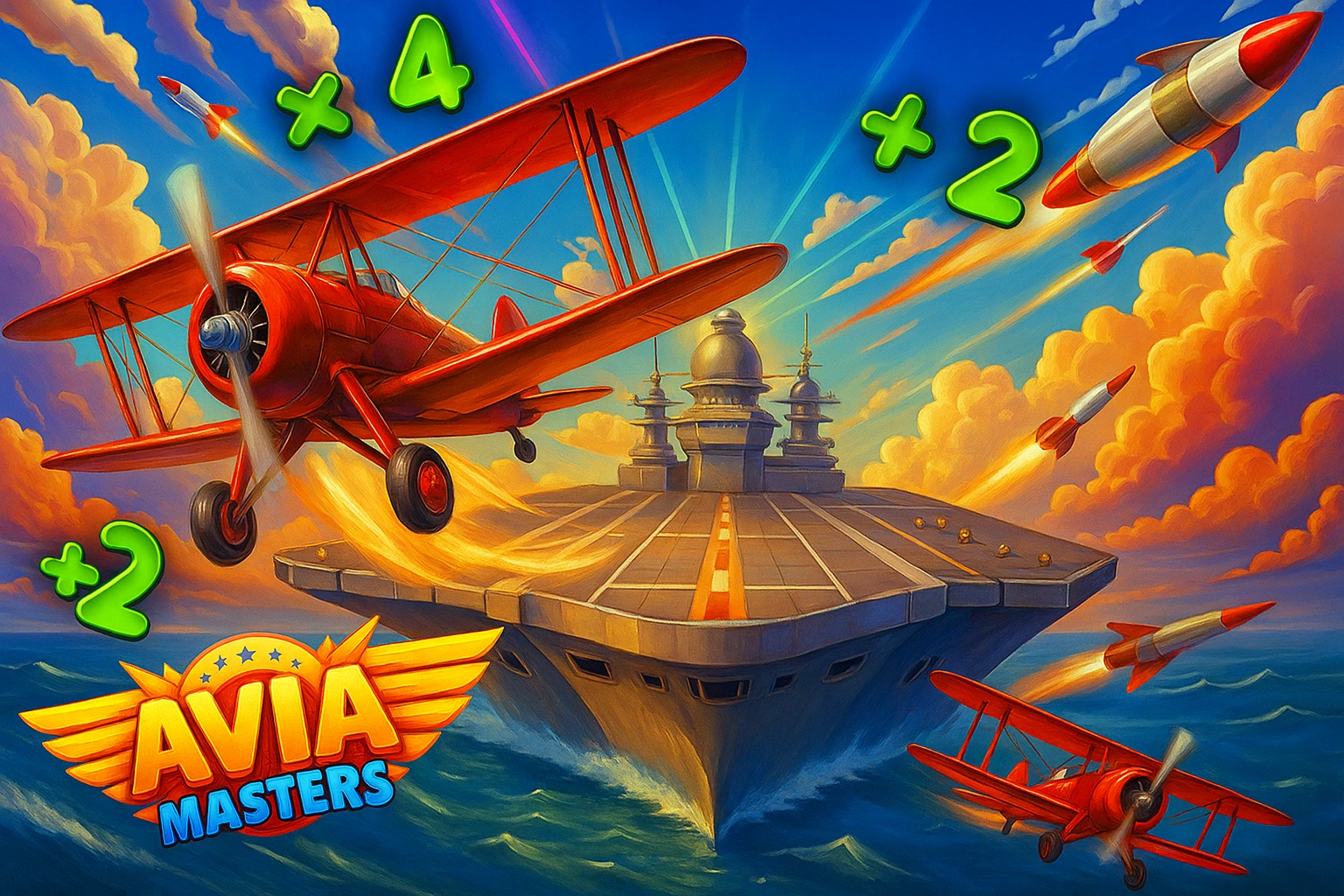
The aircraft bounces off floating objects during flight. Green multipliers (+1, +2, +5, +10) add to the balance. Blue multipliers (x2, x3, x4, x5) multiply it. Red rockets cut everything in half and drag the plane downward. Safe landing on the destination carrier pays out the accumulated balance. Ocean crash means total loss of the bet.
That’s the entire Avia Masters game. No hidden mechanics, no complex rules. The challenge comes from the randomized placement of multipliers and rockets each round. Sometimes the plane hits three x5 multipliers in succession for massive wins. Other rounds pack so many rockets that survival becomes unlikely regardless of skill or strategy. The RNG determines object placement before takeoff – nothing changes it mid-flight.
| 1️⃣ | Register / Log In | Create an account or log in to your existing one to start playing. |
| 2️⃣ | Choose a Game | Select your preferred game mode (demo or real). |
| 3️⃣ | Set Your Stake | Decide how much you want to stake before each round. |
| 4️⃣ | Start the Round | Launch the game and follow the on-screen instructions. |
| 5️⃣ | Watch & Decide | Observe the flight, decide when to cash out before the crash. |
| 6️⃣ | Collect Your Winnings | If you cashed out in time, your stake multiplies and is added to your balance. |
Setting Up Your First Round on Stake
The betting interface sits at the bottom of the screen with a simple slider ranging from $0.10 to $1,050. These limits accommodate everyone from cautious beginners to high-stakes players chasing maximum 250x payouts. Drag the slider or type the exact amount – both methods work instantly.
The green Play button launches the plane immediately. No waiting for other players, no countdown timers. Click it and the aircraft takes off from the carrier deck within milliseconds. The game displays the bet amount above the plane as the Counter Balance, which becomes the starting point for all calculations during flight. Hit a +10 multiplier with a $5 bet showing, and the Counter Balance jumps to $15. Hit a x3 multiplier next, and it becomes $45.
This Counter Balance represents potential winnings throughout the flight. The number grows with green multipliers, multiplies with blue ones, and gets slashed by rockets. Only successful carrier landings convert this balance into actual payouts. The final Counter Balance at touchdown equals the exact payout amount – no hidden calculations or mysterious deductions. A $10 bet that accumulates to $87.50 through various multipliers pays exactly $87.50 upon safe landing.
Stakes this wide serve different purposes. Minimum bets let players experience hundreds of rounds without significant risk. Maximum bets turn single lucky flights into five-figure paydays. Most Aviamasters Stake players find their comfort zone between $1 and $25, balancing excitement with bankroll preservation.
Flight Path Mechanics
Multiplier Collision Physics
The plane ricochets off multipliers like a pinball against bumpers. Addition multipliers (+1, +2, +5, +10) create predictable bounces – the plane angles upward at roughly 45 degrees regardless of approach angle. These green multipliers add their value directly to the Counter Balance while providing crucial altitude boosts that keep flights alive.
Multiplication multipliers (x2, x3, x4, x5) behave differently. The bounce angle varies based on impact speed and trajectory, creating more chaotic flight paths. These blue multipliers transform modest balances into significant sums instantly. A $20 Counter Balance hitting x5 becomes $100 in one collision. The physics engine calculates each bounce independently, meaning consecutive multiplier hits can send the plane soaring toward the ceiling or barely maintaining altitude depending on impact angles.

Each collision adds approximately 10-15% altitude regardless of multiplier type. This mechanic ensures that multiplier-rich flights tend to succeed while rocket-heavy paths lead to ocean crashes.
Rocket Impact Zones
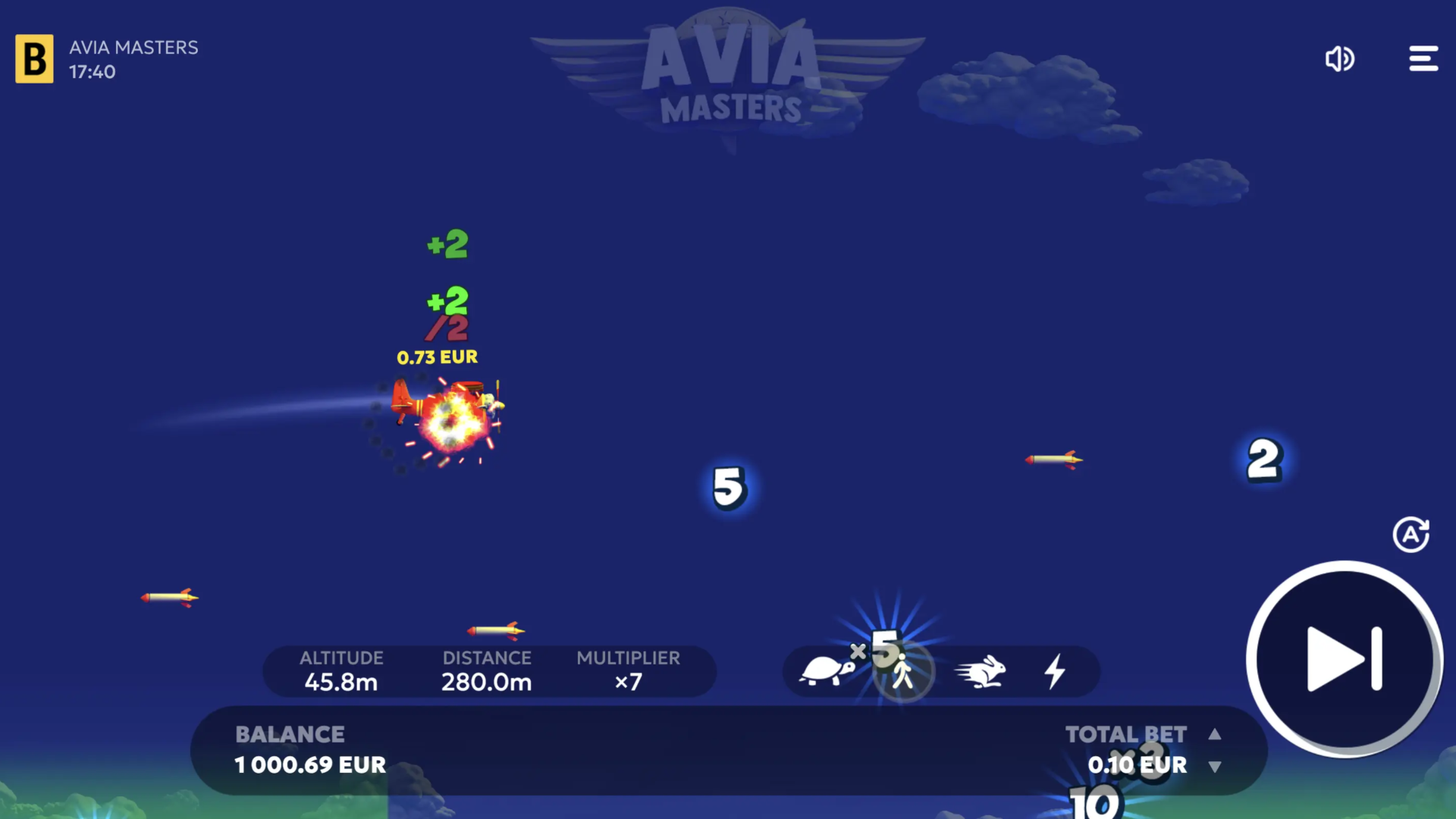
Rockets spawn between multipliers with deliberate malice. The RNG places them at heights that intercept common flight paths, forcing planes through dangerous zones. These red obstacles appear more frequently at middle altitudes where most flights cruise.
Contact with any rocket triggers two simultaneous penalties. First, the Counter Balance divides by two – $100 becomes $50 instantly. Second, the plane loses 20-30% altitude depending on impact angle. Head-on collisions cause maximum altitude loss while glancing blows reduce height minimally. Three rocket hits typically doom a flight regardless of accumulated multipliers. The combination of halved winnings and lost altitude creates a death spiral toward the ocean.
Landing vs Crashing
Successful carrier landings require maintaining minimum 15% altitude when reaching the destination ship. Below this threshold, physics takes over – the plane lacks sufficient height to reach the deck regardless of forward momentum. The altitude meter on the dashboard turns red below 20% as a warning.
Planes above 15% altitude initiate landing sequences automatically upon reaching the carrier. The animation shows brake flaps deploying and wheels extending before touchdown. This sequence takes approximately one second and cannot fail once initiated – if the landing starts, the payout is guaranteed. Crashes happen instantly when altitude drops to zero, accompanied by a splash animation and immediate loss of the entire bet. No partial payouts exist in how to play avia masters – flights either pay their full accumulated balance or nothing.
Speed Control for Aviamasters Game
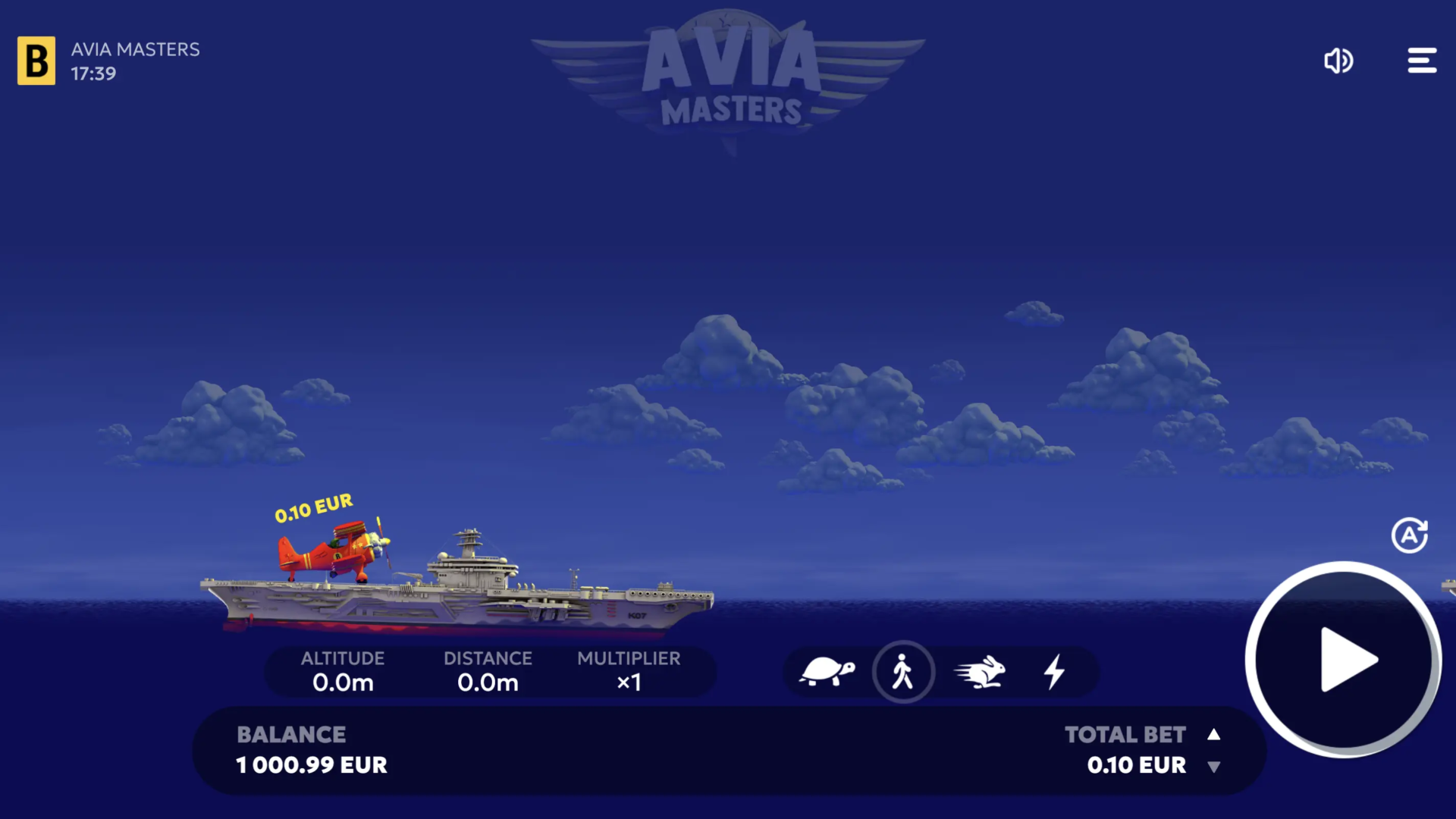
Four speed settings control the Aviamasters game pace. Turtle mode crawls through every bounce and collision, perfect for understanding the physics during initial sessions. Each multiplier impact plays out in slow motion, making it obvious how altitude changes correlate with balance modifications.
Walking speed serves as the default for good reason. Flights last 5-15 seconds typically, providing enough time to track the Counter Balance without dragging. Rabbit speed accelerates everything by roughly 2x – experienced players prefer this for grinding through hundreds of rounds. Lightning speed makes flights flash by in 2-3 seconds, useful primarily for autoplay sessions where manual tracking becomes irrelevant.
The faster the speed, the harder it becomes to process what’s happening. Lightning mode shows the plane zipping through multipliers so quickly that individual collisions blur together. The Counter Balance updates become impossible to follow in real-time. This explains why beginners struggle at high speeds – they miss crucial information about how their balance evolves during flight. Meanwhile, turtle speed reveals every detail but makes sessions feel interminable. Watching 100 rounds at turtle pace takes over an hour compared to 15 minutes at rabbit speed.
Long session players typically settle on rabbit speed. Fast enough to maintain engagement, slow enough to track important moments. The sweet spot for most play Aviamasters sessions where manual betting combines with occasional autoplay runs.
Stake.com vs Stake.us Differences
The international Stake.com accepts players worldwide except restricted countries, while Stake.us serves exclusively American players in permitted states. This fundamental split creates numerous operational differences despite both platforms hosting identical versions of Avia Masters Atake.
Deposits reveal the biggest contrast. Stake.com processes 30+ cryptocurrencies directly – Bitcoin, Ethereum, Dogecoin, and exotic altcoins. Stake.us limits options to purchasing their Gold Coins and Stake Cash through credit cards or cryptocurrency. The international platform enables instant withdrawals in crypto, while the US version requires redemption requests for cash prizes that process within 1-3 business days.
The 97% RTP remains constant across both platforms since BGaming provides the same game build. However, bonus structures differ completely. Stake.com offers traditional deposit bonuses, rakeback, and VIP rewards paid in real money. Stake.us operates on a sweepstakes model where players receive Stake Cash as bonuses, redeemable for prizes but technically not gambling under US law.
Verification requirements vary too. Stake.com allows anonymous play up to certain limits. Stake.us demands full KYC immediately – social security number, address verification, the complete package. This stems from different regulatory frameworks rather than platform preference.
Maximum bets stay identical at $1,050 per round, but minimum bets sometimes differ based on current promotions. The international version occasionally drops minimums to $0.01 during special events.

Reading the Dashboard
The dashboard displays three critical metrics during every Aviamasters flight. Understanding these numbers separates random clicking from informed play. Each indicator tells part of the story – combined, they reveal whether celebration or disappointment awaits.
Altitude Indicator
Altitude percentage determines survival probability more than any other metric. At 80% altitude, planes almost always reach the carrier regardless of remaining distance. Drop below 30% and physics dominates – the aircraft struggles to maintain forward momentum, typically splashing within seconds.
The color coding provides instant visual feedback. Green above 50%, yellow between 20-50%, red below 20%. Red means prepare for impact. Once altitude hits 15%, landing becomes mathematically impossible even if the carrier sits directly ahead. The plane simply lacks vertical space to complete descent procedures. Rockets typically steal 20-30% altitude per hit, meaning three direct impacts usually spell doom regardless of starting height.
Distance Traveled
Distance shows horizontal progress toward the destination carrier, measured in arbitrary units that increase steadily during flight. Long flights often correlate with higher multipliers simply because more time means more collisions. But correlation isn’t causation.
A plane traveling 500 distance units through mostly +1 multipliers might accumulate $30 from a $10 bet. Another plane covering 200 units but hitting consecutive x5 multipliers could reach $250. The Avia Masters plane game rewards quality of collisions over quantity. Distance serves mainly as a progress indicator – high distance with low altitude usually means imminent crash, while low distance with high altitude suggests plenty of flight remaining.
Current Multiplier Display
The multiplier display shows real-time accumulated value – essentially what the payout would be if landing happened immediately. This number updates instantly with each collision, jumping dramatically on multiplication symbols and climbing steadily through addition zones.
Seeing x50 means nothing if altitude reads 5%. The plane won’t reach the carrier regardless of accumulated wealth. Conversely, x2 at 90% altitude almost guarantees doubling the initial bet. Context matters more than raw numbers. Experienced players watch altitude first, multiplier second. Beginners do the opposite and wonder why their x100 balances keep crashing into the ocean.
Autoplay Setup
Stop Conditions prevent autoplay from draining entire bankrolls during unlucky streaks. The “Stop if balance decreases by” setting acts as a loss limit – set it to 50% and autoplay halts after losing half the starting amount. The “Stop if balance increases by” option locks in profits – reaching double the initial bankroll triggers an automatic pause.
The “Stop on any win above” condition captures big multipliers without babysitting every round. Set it to x50 and walk away. Return to either disappointment or a pleasant surprise. Most players running how to play Avia Masters on Stake sessions find 10-20 rounds optimal for testing strategies. Longer runs risk significant losses during cold streaks. Shorter sessions don’t provide enough data to evaluate approaches.
Beginners make three consistent autoplay mistakes. First, they set no stop conditions, allowing hundreds of rounds to run unchecked. Bankrolls evaporate while they’re making coffee. Second, they use maximum speed during autoplay, making it impossible to review what happened. When 100 rounds flash by in three minutes, learning becomes impossible. Third, they set stop-loss limits too tight. Stopping after any 10% decrease means constantly restarting autoplay since normal variance triggers the condition repeatedly.
VIP farmers discovered that running 500+ rounds overnight at minimum bets accumulates significant loyalty points. Set conservative stop conditions, use rabbit speed for stability, and let the Aviamasters algorithm work. The accumulated wagering contributes toward monthly bonuses and rakeback calculations without requiring active participation. Just ensure the stop-loss prevents complete bankroll destruction if variance turns ugly.
Common Mistakes Made by Beginners
The gambler’s fallacy destroys bankrolls faster than rockets destroy planes. After five consecutive crashes, beginners convince themselves that the sixth round “must” succeed. The Aviamasters doesn’t track previous outcomes. Round 1,000 has identical crash odds as round 1. The RNG generates fresh randomness every flight without consulting history.
Starting with $100 bets before understanding basic mechanics ranks as the second most expensive error. New players see the $1,050 maximum and assume bigger bets equal bigger wins. They’re technically correct – bigger bets do create bigger wins. Also bigger losses. Much bigger losses. The Avia Masters casino math stays constant regardless of stake size. That 52% crash rate hits equally hard whether betting dimes or thousands.
Speed changes affect perception, not probability.
Lightning speed doesn’t make crashes more likely. Turtle speed doesn’t improve landing chances. The server determines outcomes before the visual animation begins. Switching from rabbit to turtle mid-flight changes nothing except how quickly disappointment or celebration arrives. Yet beginners constantly adjust speed thinking they’ve discovered some hidden advantage.
“Hot” and “cold” periods exist only in memory, not mathematics. Ten wins in a row means nothing for round eleven. Twenty crashes don’t “charge up” the system for a big payout. The 97% RTP applies across millions of rounds, not individual sessions. Players experiencing good runs attribute it to timing rather than variance. Bad runs get blamed on the game being “cold” rather than probability. Both interpretations are wrong.
Winning Patterns That Don’t Exist
RNG means Random Number Generator. Random means no patterns. No patterns means prediction equals guessing.
The how to play Avia Masters YouTube videos promoting “guaranteed strategies” sell false hope to desperate gamblers. One popular video claims rockets appear in predictable sequences. Another swears multipliers follow mathematical progressions. A third insists that bet sizing influences outcomes. All lies, whether intentional or delusional. The Provably Fair system makes manipulation impossible – each round’s outcome gets locked before the plane launches.
BGaming publishes the hash before each round starts. After the round ends, they reveal the seed. Anyone can verify that the predetermined outcome matches what actually happened. This transparency proves that no external factors – not bet size, not timing, not previous results – influence where multipliers and rockets spawn. The algorithm doesn’t know or care who’s playing, how much they’re betting, or how many times they’ve lost.
“Secret strategies” exist because humans excel at finding patterns in randomness. Watch enough rounds and the brain creates connections that don’t exist. That’s why slot players believe in “loose” machines and roulette addicts track hot numbers. The Aviamasters version involves timing bets to imaginary cycles or adjusting stakes based on fictional patterns.
Analysis of Video Tutorials
Most how to play Avia Masters on Stake tutorials fall into three categories: genuinely helpful, accidentally misleading, or deliberately deceptive.
The helpful ones explain interface basics – where to find the bet slider, how to activate autoplay, what the dashboard numbers mean. BGaming’s official channel provides clean, accurate tutorials without false promises. They show mechanics without implying secret knowledge. These videos typically run 3-5 minutes and stick to facts.
Accidentally misleading content comes from streamers who misunderstand variance. They hit a x200 multiplier during a session and immediately create “THE METHOD THAT MADE ME RICH” videos. They genuinely believe their betting pattern caused the win rather than random chance. These creators aren’t lying – they’re just statistically illiterate. Their strategies “work” the same way a lucky rabbit’s foot “works” – through coincidence and selective memory.
Deliberately deceptive videos promote affiliate links above truth. These creators know their strategies don’t work but need content to drive traffic. They show carefully edited sessions hiding hundreds of losses while highlighting rare wins. The tell: they never show long unedited sessions. Another tell: constant emphasis on using their specific casino link for “better odds” – a mathematical impossibility since Aviamasters runs on the same servers everywhere.
Streamers win more often for one simple reason: volume. Playing 8 hours daily means experiencing more high multipliers than casual players see in months. Plus, many receive sponsored balances from casinos. Losing $10,000 of house money doesn’t sting like losing $100 of rent money. They can chase Avia Masters max win scenarios without sweating losses, creating an illusion of success that regular players can’t replicate.
Gameplay Questions
Can the flight path be predicted?
Does bet size affect multiplier frequency?
Why does my plane crash more at night?
Is there a pattern to rocket spawns?
Can speed changes improve odds?
What determines the starting altitude?